Hope for the Wicked combines several genres seamlessly. It has elements of the wise-cracking PI novel, the suspense thriller. and the horror shockfest. Even though the chassis this thing's built on is a hard-boiled detective story (the kind where the investigators get pulled deeper and deeper into an ugly underworld), I'd say the book would appeal most to horror fans. One reason is that the PIs are only PIs for a short time, and then they revert back to their old jobs as hired assassins. But the biggest reason this book will likely not appeal to your typical suspense reader is that it deals with subject matter that is extremely dark and discomfiting.
One thing that struck me while reading this book was that Lorn isn't afraid to take risks. There is one storytelling choice in particular that demonstrates that the man has rather large balls. Very large and admirable balls. And what I'm talking about here has nothing to do with the graphic subject matter, the pervasive theme of child abuse, the scenes of extreme violence and gore. I can't tell you what I'm referring to, actually. To do so would ruin the story for you.
You'll just have to read it to find out.
Not for the squeamish.
Seriously.
Wednesday, February 12, 2014
Sunday, February 9, 2014
Escaping Barcelona by Henry Martin
I don't read literary fiction that's much concerned with realism very often. I usually like a bit of the absurd, the surreal, or the fantastical mixed in. The "straight n' serious" stuff usually isn't for me. So, when I was asked to read this book in exchange for an honest review, I was a bit hesitant. But I'm glad I took a chance on it.
This is a story about the down and out, and I'm generally pretty fond of some grit and grime. Martin does a good job of getting inside the head of a 19 year-old runaway named Rudy and exposing thought processes and observations that are often embarrassingly earnest, wildly idealistic, and excruciatingly naive. Rudy thinks a lot of the same shit I was thinking when I was that age, the kind of shit that I can only shake my head in wonder at now.
Rudy isn't a sympathetic character, but he's a compelling one. I wanted to keep reading to find out where he would end up. But my lack of sympathy for Rudy was something that kept nettling me while I was reading this. After being sexually assaulted (and having his passport stolen) in a strange land where he can't speak the language, Rudy steadfastly refuses to reach out to his family for help. The reason why he never reaches out to his family for help is never explained. There is no hint at an abusive home life or anything of the sort. It just seems like he'd rather live on the street and risk starvation than simply swallow his pride.
Another thing that nettled me a bit was that it was never clear what language Rudy spoke (and I believe this was intentional). He visits Spain on a lark and it's made plain that he can't speak Spanish and that he only knows 50 or so words in English, yet it seems that he's able to communicate with a good number of street people (and the police) without much difficulty. This wasn't a huge issue. But I do think the vagueness of Rudy's native language served to over-complicate things, and it became somewhat distracting for this reader.
Aside from these two nettling bits, I found Escaping Barcelona pretty engrossing. The writing is smooth and draws you through the story. I read it in just a few sittings. Martin does a fantastic job evoking a sense of place and the people who inhabit the streets of Barcelona. It reeked of verisimilitude. I'd be surprised to find that the author hasn't spent a good deal of time in that city.
This book is the first part of a trilogy called Mad Days of Me. I've already decided to pick up the next one in the series. I'm still pretty curious about where Rudy will end up.
This is a story about the down and out, and I'm generally pretty fond of some grit and grime. Martin does a good job of getting inside the head of a 19 year-old runaway named Rudy and exposing thought processes and observations that are often embarrassingly earnest, wildly idealistic, and excruciatingly naive. Rudy thinks a lot of the same shit I was thinking when I was that age, the kind of shit that I can only shake my head in wonder at now.
Rudy isn't a sympathetic character, but he's a compelling one. I wanted to keep reading to find out where he would end up. But my lack of sympathy for Rudy was something that kept nettling me while I was reading this. After being sexually assaulted (and having his passport stolen) in a strange land where he can't speak the language, Rudy steadfastly refuses to reach out to his family for help. The reason why he never reaches out to his family for help is never explained. There is no hint at an abusive home life or anything of the sort. It just seems like he'd rather live on the street and risk starvation than simply swallow his pride.
Another thing that nettled me a bit was that it was never clear what language Rudy spoke (and I believe this was intentional). He visits Spain on a lark and it's made plain that he can't speak Spanish and that he only knows 50 or so words in English, yet it seems that he's able to communicate with a good number of street people (and the police) without much difficulty. This wasn't a huge issue. But I do think the vagueness of Rudy's native language served to over-complicate things, and it became somewhat distracting for this reader.
Aside from these two nettling bits, I found Escaping Barcelona pretty engrossing. The writing is smooth and draws you through the story. I read it in just a few sittings. Martin does a fantastic job evoking a sense of place and the people who inhabit the streets of Barcelona. It reeked of verisimilitude. I'd be surprised to find that the author hasn't spent a good deal of time in that city.
This book is the first part of a trilogy called Mad Days of Me. I've already decided to pick up the next one in the series. I'm still pretty curious about where Rudy will end up.
Thursday, February 6, 2014
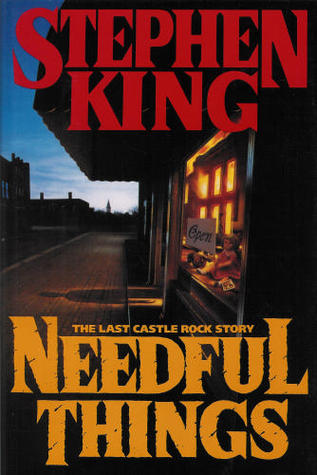
Needful Things by Stephen King
Mr. King likes to tell stories about people getting trapped. He's got one about a guy trapped in a bedroom. He's got a whole bunch of these stories, really. He's got people trapped inside a car, in a gas station, a classroom, a grocery store, a hotel, on an island, a city under a giant force field. I'm pretty sure he's got one about a lady handcuffed to a bed for the whole book. I'm just going from memory here. He's probably got a lot more.
In Needful Things, the entire town of Castle Rock is trapped by their possessions. Its citizens are punished mercilessly for 700+ pages with some special brand of evil that feeds off the sin of imbuing bric-à-brac with sentimental value.
Admittedly, I'm oversimplifying the plot of this book quite a bit. But Needful Things is just a morality tale at its core, a boldfaced warning about materialism. The message of the book seems to boil down to something we all heard as kids, mom saying that you don't need those roller skates, you just want them.
But to say that this is only a simple morality tale really does this book a disservice. It's got all the things I like in a King book: suspense, action, gore, folksy humor (the cruel and the crude varieties), characters you can identify with, protagonists you care about, insane people and perverts, monsters and great big explosions. Most importantly, it's got a great villain. Our bad guy, Leland Gaunt, isn't subtle, he chews up the scenery at every turn, but he's exactly what this novel calls for. Done well (and King does them very well), comic book villains are the best kind. All right, maybe just the most fun to read about.
And, yes, this book had some of the Stephen King things I don't like so much. I feel sometimes King is writing down to his characters, like he'll create a character just for the sake of mockery. Lester Pratt, the goody two-shoes, Christian 'boy scout' character in this book is a prime example. I would be willing to bet that no one ever--no matter how repressed and/or brainwashed, sheltered, or close-minded--ever, ever had an internal monologue that's featured the celebratory phrase "rooty toot toot" repeatedly while thinking about the prospect of getting some pussy.
King also has a tendency to veer into some rather cloying, almost treacly, Garrison Keillor territory, and in this book the opening and closing are perhaps the most nauseating examples of this that I've personally encountered.
And then, like with many of King's novels, we have the borderline deus ex machina ending.
Now, I know what you're thinking:
Wow, it seemed like there for a minute you were saying you like Stephen King. But now it seems like you're being rather hard on the guy.
But, you see, the thing is, Stephen King is sort of like the President of the United States of America. (Bear with me here.) The people you hear bitching about the President the most, the people who are the hardest on him, seem to always be the very same people who voted him into office. I've read over thirty books by Stephen King. So, in my mind, that pretty much means I voted that son-of-a-bitch into office over thirty fucking times!
I'll say what I want.
And now you're probably asking, would you vote for that son-of-a-bitch again?
No question.
In Needful Things, the entire town of Castle Rock is trapped by their possessions. Its citizens are punished mercilessly for 700+ pages with some special brand of evil that feeds off the sin of imbuing bric-à-brac with sentimental value.
Admittedly, I'm oversimplifying the plot of this book quite a bit. But Needful Things is just a morality tale at its core, a boldfaced warning about materialism. The message of the book seems to boil down to something we all heard as kids, mom saying that you don't need those roller skates, you just want them.
But to say that this is only a simple morality tale really does this book a disservice. It's got all the things I like in a King book: suspense, action, gore, folksy humor (the cruel and the crude varieties), characters you can identify with, protagonists you care about, insane people and perverts, monsters and great big explosions. Most importantly, it's got a great villain. Our bad guy, Leland Gaunt, isn't subtle, he chews up the scenery at every turn, but he's exactly what this novel calls for. Done well (and King does them very well), comic book villains are the best kind. All right, maybe just the most fun to read about.
And, yes, this book had some of the Stephen King things I don't like so much. I feel sometimes King is writing down to his characters, like he'll create a character just for the sake of mockery. Lester Pratt, the goody two-shoes, Christian 'boy scout' character in this book is a prime example. I would be willing to bet that no one ever--no matter how repressed and/or brainwashed, sheltered, or close-minded--ever, ever had an internal monologue that's featured the celebratory phrase "rooty toot toot" repeatedly while thinking about the prospect of getting some pussy.
King also has a tendency to veer into some rather cloying, almost treacly, Garrison Keillor territory, and in this book the opening and closing are perhaps the most nauseating examples of this that I've personally encountered.
And then, like with many of King's novels, we have the borderline deus ex machina ending.
Now, I know what you're thinking:
Wow, it seemed like there for a minute you were saying you like Stephen King. But now it seems like you're being rather hard on the guy.
But, you see, the thing is, Stephen King is sort of like the President of the United States of America. (Bear with me here.) The people you hear bitching about the President the most, the people who are the hardest on him, seem to always be the very same people who voted him into office. I've read over thirty books by Stephen King. So, in my mind, that pretty much means I voted that son-of-a-bitch into office over thirty fucking times!
I'll say what I want.
And now you're probably asking, would you vote for that son-of-a-bitch again?
No question.
Saturday, February 1, 2014
2014 Campbellian Anthology (M. David Blake, Curator)
M. David Blake’s 2014 Campbellian Anthology is now available. This book attempts to collect in one volume representative works by most of the writers eligible for this year’s John W. Campbell Award for Best New Writer. It contains more than 860,000 words of fiction by 111 authors.
And it's not just FREE, it's DRM-FREE.
I hear it’s only available for a limited time, so you might want to grab a copy soon. Chances are good you'll find a damn fine story by a new up-and-coming writer you've never heard of before.
Why not download a copy now?
Mobi file, for Amazon Kindle and Kindle Readers apps:
http://rampantloonmedia.com/downloads/2014CampbellianAnthology_Kindle.mobi
Epub file, for iPad, Nook, Kobo, Sony Reader, and most other e-reader devices and apps:
http://rampantloonmedia.com/downloads/2014CampbellianAnthology_iPad-nook-Kobo-Sony.epub
I hear it’s only available for a limited time, so you might want to grab a copy soon. Chances are good you'll find a damn fine story by a new up-and-coming writer you've never heard of before.
Why not download a copy now?
Mobi file, for Amazon Kindle and Kindle Readers apps:
http://rampantloonmedia.com/downloads/2014CampbellianAnthology_Kindle.mobi
Epub file, for iPad, Nook, Kobo, Sony Reader, and most other e-reader devices and apps:
http://rampantloonmedia.com/downloads/2014CampbellianAnthology_iPad-nook-Kobo-Sony.epub
Friday, January 24, 2014
Locked Room: A Katla KillFile by Martyn V. Halm
I found this piece thoroughly enjoyable, even though it falls into a genre I don't read much of (crime/thriller). This is a short story, so it's hard to talk about what I liked about it without giving too much away. I'll just say that the attention to detail is fantastic (I like learning about how things work) and that this story stimulates the same pleasure center in your brain that a good heist story tickles.
Wednesday, January 22, 2014
Dweller by Jeff Strand
Jeff Strand lived in Ohio for a number of years and yet it's apparent that he didn't research* the Ohio Sasquatch before writing this book. Unlike the creature portrayed in Dweller, the line of Sasquatch native to Ohio does not have a mouth full of gnarly teeth and flesh-ripping talons. And the Ohio Sasquatch most certainly doesn't eat people! The Ohio Sasquatch is an herbivore and not savage in any way. In fact, you'll see Sasquatch all over Ohio lending a helping hand in various human communities, ladling out hearty homemade stews at local soup kitchens, working together to build playgrounds in poor neighborhoods, and serving as volunteer firefighters. This is not to say that there aren't lines of Sasquatch that fit Strand's description. They're just not found in Ohio. If he'd added one minor detail regarding the Sasquatch's origins in this book, it would have proved to be much more believable. Simply changing the title to A Kentucky Sasquatch in Ohio would have lent the work the authenticity it so desperately needs.
But how was the story? Early on, I suspected this was going to be basically a retelling of Stephen King's Carrie. Just substitute Sasquatch for telekinesis. But I was pleasantly surprised to find that this wasn't to be the case. I won't say any more than that. Pick it up and see for yourself what it's all about. You won't be disappointed.
*The only alternative to Strand's not having researched the Ohio Sasquatch is that he wrote this book to intentionally demonize them. Based on Strand's generally amicable online presence, I can't see this as being a realistic proposition.
But how was the story? Early on, I suspected this was going to be basically a retelling of Stephen King's Carrie. Just substitute Sasquatch for telekinesis. But I was pleasantly surprised to find that this wasn't to be the case. I won't say any more than that. Pick it up and see for yourself what it's all about. You won't be disappointed.
*The only alternative to Strand's not having researched the Ohio Sasquatch is that he wrote this book to intentionally demonize them. Based on Strand's generally amicable online presence, I can't see this as being a realistic proposition.
Sunday, January 19, 2014
The Island of Dr. Moreau by H.G. Wells
Many will dismiss Wells' tale as a racist's fever dream, a parable that blames the failings of English imperialism on subjects who were just too beastly to be properly civilized. And it would be easy to do so. Wells was a vocal proponent of Eugenics, and the text of this book does contain passages like the ones I've reproduced below.
First, Moreau tells of how he used the delicate art of vivisection to carve a 'negroid type' out of an ape he had on hand:
“Then I took a gorilla I had; and upon that, working with infinite care and mastering difficulty after difficulty, I made my first man. All the week, night and day, I moulded him. With him it was chiefly the brain that needed moulding; much had to be added, much changed. I thought him a fair specimen of the negroid type when I had finished him..."
Then our protagonist describes another of Moreau's creations:
"The Satyr was a gleam of classical memory on the part of Moreau,—his face ovine in expression, like the coarser Hebrew type; his voice a harsh bleat, his nether extremities Satanic. He was gnawing the husk of a pod-like fruit as he passed us."
Although the above passages seem to be fairly damning evidence of a racially motivated agenda, I would suspect that Wells' prejudices inadvertently seeped into his narrative while, perhaps intentionally, writing another parable altogether. This work could just as easily be read as a warning against what he believed happens when a society turns its back on God and religion. Then again, he could simply have been writing a tale about the dangers of science in the hands of insane and wicked men.
And I think it's because of the various ways this story can be interpreted that it's been a perrenial favorite and will continue to be so for years to come.
Or, its staying power could be merely the result of Wells having written a great, imaginative story.
I particularly liked the scenes in which Moreau explains himself.
"To this day I have never troubled about the ethics of the matter[...] The study of Nature makes a man at last as remorseless as Nature."
I also was struck by the unexplored horrific cinematic possibilities of a film wherein Moreau's method of carving humanity into beasts using vivisection is shown in all its gory detail. Imagine a scene with Moreau carving up a beast in his laboratory with a voiceover of his monologue on pain playing throughout:
"The capacity for pain is not needed in the muscle, and it is not placed there,—is but little needed in the skin, and only here and there over the thigh is a spot capable of feeling pain. Pain is simply our intrinsic medical adviser to warn us and stimulate us. Not all living flesh is painful; nor is all nerve, not even all sensory nerve. There's no taint of pain, real pain, in the sensations of the optic nerve. If you wound the optic nerve, you merely see flashes of light,—just as disease of the auditory nerve merely means a humming in our ears. Plants do not feel pain, nor the lower animals; it's possible that such animals as the starfish and crayfish do not feel pain at all. Then with men, the more intelligent they become, the more intelligently they will see after their own welfare, and the less they will need the goad to keep them out of danger. I never yet heard of a useless thing that was not ground out of existence by evolution sooner or later. Did you? And pain gets needless."
“Then I am a religious man [...] as every sane man must be. It may be, I fancy, that I have seen more of the ways of this world's Maker than you,—for I have sought his laws, in my way, all my life [...] And I tell you, pleasure and pain have nothing to do with heaven or hell. Pleasure and pain—bah! What is your theologian's ecstasy but Mahomet's houri in the dark? This store which men and women set on pleasure and pain [...] is the mark of the beast upon them,—the mark of the beast from which they came! Pain, pain and pleasure, they are for us only so long as we wriggle in the dust."
First, Moreau tells of how he used the delicate art of vivisection to carve a 'negroid type' out of an ape he had on hand:
“Then I took a gorilla I had; and upon that, working with infinite care and mastering difficulty after difficulty, I made my first man. All the week, night and day, I moulded him. With him it was chiefly the brain that needed moulding; much had to be added, much changed. I thought him a fair specimen of the negroid type when I had finished him..."
Then our protagonist describes another of Moreau's creations:
"The Satyr was a gleam of classical memory on the part of Moreau,—his face ovine in expression, like the coarser Hebrew type; his voice a harsh bleat, his nether extremities Satanic. He was gnawing the husk of a pod-like fruit as he passed us."
Although the above passages seem to be fairly damning evidence of a racially motivated agenda, I would suspect that Wells' prejudices inadvertently seeped into his narrative while, perhaps intentionally, writing another parable altogether. This work could just as easily be read as a warning against what he believed happens when a society turns its back on God and religion. Then again, he could simply have been writing a tale about the dangers of science in the hands of insane and wicked men.
And I think it's because of the various ways this story can be interpreted that it's been a perrenial favorite and will continue to be so for years to come.
Or, its staying power could be merely the result of Wells having written a great, imaginative story.
I particularly liked the scenes in which Moreau explains himself.
"To this day I have never troubled about the ethics of the matter[...] The study of Nature makes a man at last as remorseless as Nature."
I also was struck by the unexplored horrific cinematic possibilities of a film wherein Moreau's method of carving humanity into beasts using vivisection is shown in all its gory detail. Imagine a scene with Moreau carving up a beast in his laboratory with a voiceover of his monologue on pain playing throughout:
"The capacity for pain is not needed in the muscle, and it is not placed there,—is but little needed in the skin, and only here and there over the thigh is a spot capable of feeling pain. Pain is simply our intrinsic medical adviser to warn us and stimulate us. Not all living flesh is painful; nor is all nerve, not even all sensory nerve. There's no taint of pain, real pain, in the sensations of the optic nerve. If you wound the optic nerve, you merely see flashes of light,—just as disease of the auditory nerve merely means a humming in our ears. Plants do not feel pain, nor the lower animals; it's possible that such animals as the starfish and crayfish do not feel pain at all. Then with men, the more intelligent they become, the more intelligently they will see after their own welfare, and the less they will need the goad to keep them out of danger. I never yet heard of a useless thing that was not ground out of existence by evolution sooner or later. Did you? And pain gets needless."
“Then I am a religious man [...] as every sane man must be. It may be, I fancy, that I have seen more of the ways of this world's Maker than you,—for I have sought his laws, in my way, all my life [...] And I tell you, pleasure and pain have nothing to do with heaven or hell. Pleasure and pain—bah! What is your theologian's ecstasy but Mahomet's houri in the dark? This store which men and women set on pleasure and pain [...] is the mark of the beast upon them,—the mark of the beast from which they came! Pain, pain and pleasure, they are for us only so long as we wriggle in the dust."
Wednesday, January 15, 2014
Jeffrey Ford Story in SUBTERRANEAN PRESS MAGAZINE (Winter 2014 Issue)
If you've not had the pleasure of reading a story by Jeffrey Ford, here's an opportunity to do so risk-free. His story "The Prelate’s Commission" is in the Winter 2014 edition of Subterranean Press Magazine.
You can read it online here.
Or you can download a FREE copy of the magazine in which it appears in either MOBI or EPUB formats.
You can read it online here.
Or you can download a FREE copy of the magazine in which it appears in either MOBI or EPUB formats.
Friday, January 10, 2014
Draculas by Blake Crouch, Jack Kilborn, Jeff Strand, F. Paul Wilson
Now that I've gotten that out of the way, let me say that this is one crazy, action-packed read. It's nearly non-stop from start to finish. I liked the depiction of the vampires. They're not sexy or sophisticated. They're like sharks in a feeding frenzy. There were also a handful of nice little illustrations that highlighted some of the crazier concepts. These were a very nice touch. (See an example to your left.)
When I learned that this novel was written by FOUR(!) authors, I was pretty skeptical. I thought the mix of styles would be jarring and distracting. But I didn't find this to be the case at all. It was really pretty seamless throughout. Nice work, gentlemen. Nice work.
Tuesday, January 7, 2014
The Dinner by Herman Koch
I think I fell for every trick the author had up his sleeve on this one. I flew through this book like I was expecting the last page to reveal to me some magical secret of flight or something. Of course, it did nothing of the sort. But I love it when a book hooks me like this book hooked me.
I liked that there is one minor detail that makes this a work of science-fiction. I won't mention what that is, as that would spoil things for the reader. Also, some readers might get to the end and have no idea what little detail I'm referring to. Which is fine, it doesn't have to be a work of SF if you don't want it to be.
The writing was excellent. I was continually impressed with the apparent ease and deftness with which the author dealt with shifts in time and space. I was never lost and the switching back and forth and further back in time really added to the tension of the narrative.
The only issue I had with this book was with the basic premise. I find it hard to believe that any set of parents would agree to meet for dinner to discuss a horrible crime their children have committed. It seems to me that the likely future Prime Minster of Holland would really rather meet by a noisy waterfall and ask that everyone remove the batteries from their cell phones so as to thwart any potential eavesdroppers. The fact that this story centers around a dinner at a posh Dutch restaurant is fine. It adds a nice structure to the overall proceedings. I just saw no real need to make it explicitly a date to discuss a heinous crime over haute cuisine. It should have been treated as an 'elephant in the room' type scenario.
Recommended to people who might like to read something that's like a cross between the works of Ira Levin and Donna Tartt (75% Levin, 25% Tartt).
I liked that there is one minor detail that makes this a work of science-fiction. I won't mention what that is, as that would spoil things for the reader. Also, some readers might get to the end and have no idea what little detail I'm referring to. Which is fine, it doesn't have to be a work of SF if you don't want it to be.
The writing was excellent. I was continually impressed with the apparent ease and deftness with which the author dealt with shifts in time and space. I was never lost and the switching back and forth and further back in time really added to the tension of the narrative.
The only issue I had with this book was with the basic premise. I find it hard to believe that any set of parents would agree to meet for dinner to discuss a horrible crime their children have committed. It seems to me that the likely future Prime Minster of Holland would really rather meet by a noisy waterfall and ask that everyone remove the batteries from their cell phones so as to thwart any potential eavesdroppers. The fact that this story centers around a dinner at a posh Dutch restaurant is fine. It adds a nice structure to the overall proceedings. I just saw no real need to make it explicitly a date to discuss a heinous crime over haute cuisine. It should have been treated as an 'elephant in the room' type scenario.
Recommended to people who might like to read something that's like a cross between the works of Ira Levin and Donna Tartt (75% Levin, 25% Tartt).
Thursday, January 2, 2014
Boston Posh by Wol-vriey
Wol-vriey is the L. Frank Baum of our perverted 21st Century!
There are striking similarities in the worlds Wol-vriey builds to the Land of Oz and its various interconnected fairylands. Both authors create patchwork characters out of inanimate objects, animals, and people parts. Geography plays a large role in separating the species they invent. Characters are repeatedly hacked to pieces and reassembled through magic. Their worlds are populated with strong female characters, often wicked and powerful ones. With a few exceptions, their men are often stupid and ineffectual.
You may be asking yourself: Well, what about Wol-vriey's obsession with transgender characters? There's nothing like that in the land of Oz! Well, there you'd be wrong. Baum's Ozma was transgender. She was born a girl, was transformed into a boy to live out most of her childhood before being transformed back into a young girl again and attaining Oz's throne.
In Oz, you'll find Glass Cat. In Wol-vriey's Boston Posh, you'll find Glass Horse. Baum has Utensia, a land populated solely with kitchen utensils. In Boston Posh you have a telekinetic race of sentient Forks. Baum gives us the Wheelers, a race of creatures with wheels for hands. Wol-vriey gives us the Mermaids on Motorcycles. Both authors give us creatures made of porcelain, dragons, talking animals, and transmogrification as punishment. Both authors give us kidnapping schemes, riddles, horrible puns, and absurd quests to find bizarre magical objects. Both authors give us automatons and portals to other realms.
Wol-vriey's Boston Posh is so very much like L. Frank Baum's Oz, just with more genitalia and gore.
Highly recommended.
There are striking similarities in the worlds Wol-vriey builds to the Land of Oz and its various interconnected fairylands. Both authors create patchwork characters out of inanimate objects, animals, and people parts. Geography plays a large role in separating the species they invent. Characters are repeatedly hacked to pieces and reassembled through magic. Their worlds are populated with strong female characters, often wicked and powerful ones. With a few exceptions, their men are often stupid and ineffectual.
You may be asking yourself: Well, what about Wol-vriey's obsession with transgender characters? There's nothing like that in the land of Oz! Well, there you'd be wrong. Baum's Ozma was transgender. She was born a girl, was transformed into a boy to live out most of her childhood before being transformed back into a young girl again and attaining Oz's throne.
In Oz, you'll find Glass Cat. In Wol-vriey's Boston Posh, you'll find Glass Horse. Baum has Utensia, a land populated solely with kitchen utensils. In Boston Posh you have a telekinetic race of sentient Forks. Baum gives us the Wheelers, a race of creatures with wheels for hands. Wol-vriey gives us the Mermaids on Motorcycles. Both authors give us creatures made of porcelain, dragons, talking animals, and transmogrification as punishment. Both authors give us kidnapping schemes, riddles, horrible puns, and absurd quests to find bizarre magical objects. Both authors give us automatons and portals to other realms.
Wol-vriey's Boston Posh is so very much like L. Frank Baum's Oz, just with more genitalia and gore.
Highly recommended.
Subscribe to:
Posts (Atom)