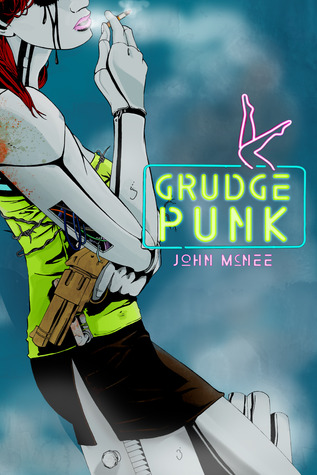
This is easily one of the best books I've read this year. It's labeled as Bizarro fiction, but I wouldn't categorize it that way. In my mind, this falls more in line with what folks a few years back were calling New Weird. It's the perfect blend of science fiction, fantasy and horror that manages to be none of those things. It's like the film Sin City set in some town in Mieville's Bas-Lag, where the citizens are all comprised of meat, metal, fiberglass, and random junkyard scraps. It's a work of gritty noir fiction. Not the hard-boiled detective variety, but rather the type concerned with the criminals, the scammers, the low-lifes, and the creeps. It's like Pulp Fiction as directed by David Cronenberg. Speaking of Cronenberg, if you like his nastier works (especially Naked Lunch and eXistenZ) and like your noir with some extra grit, then you'll like this book.
Highly recommended.
Thursday, November 14, 2013
Tuesday, November 12, 2013
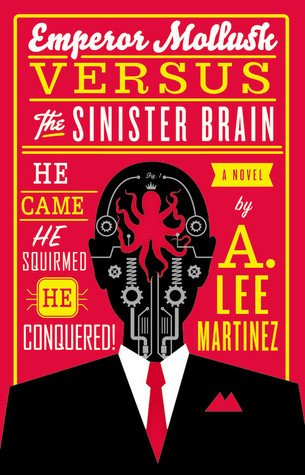
Emperor Mollusk versus The Sinister Brain by A. Lee Martinez
This book was kind of cute, kind of funny, kind of clever. It had a lot of good comic-booky, pulpy gags and settings. It had battle mechs controlled by disembodied brains, lizard people from Venus, a lost world-type island with ridiculous dinosaurs, the lost city of Atlantis, etc, etc.. You get the idea.
It moved along at a fast enough clip, but it wasn't a page-turner really. Because it was a farce, and all of the characters were cartoonish, and because you never got the sense that the villain/hero would ultimately do anything but triumph, there was little, if any, real suspense or emotional investment to keep you compulsively flipping the pages.
I can certainly respect this writer for the quality of the writing and for what he was trying to do here, but it was pretty clear that he wasn't doing it for me. I'm just not the target audience.
Why did I pick this up, if this isn't my cup of tea?
Well, I've heard a lot of good things about this author and he dedicates the book (in part) to Victor von Doom.
It moved along at a fast enough clip, but it wasn't a page-turner really. Because it was a farce, and all of the characters were cartoonish, and because you never got the sense that the villain/hero would ultimately do anything but triumph, there was little, if any, real suspense or emotional investment to keep you compulsively flipping the pages.
I can certainly respect this writer for the quality of the writing and for what he was trying to do here, but it was pretty clear that he wasn't doing it for me. I'm just not the target audience.
Why did I pick this up, if this isn't my cup of tea?
Well, I've heard a lot of good things about this author and he dedicates the book (in part) to Victor von Doom.
I do love Doctor Doom.
Friday, November 8, 2013
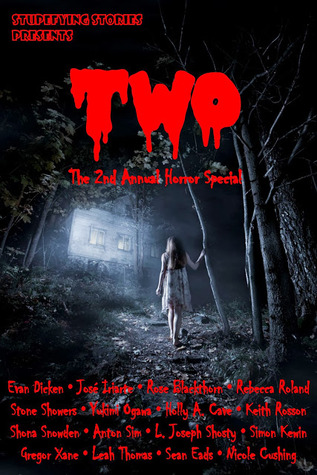
TWO: The 2nd Annual Stupefying Stories Horror Special (Anthology)
Yes, I do have a story in this anthology. So take this post for whatever you think it's worth. And, incidentally, I don't personally know the editor or any of the contributors. I've not interacted with any of the other authors electronically or otherwise. My reading of their works, and this work as a whole, I would say, is relatively unbiased. I don't know. Maybe not. Either way, it's not going to stop me from typing out my overall impressions and pointing out which stories were, to me, the stand-outs.
This is a varied collection of horror stories. There is a fairly wide range of styles and supernatural beasties represented here. It's a digital-only publication and the eBook formatting is clean and professional.
I found every story in this volume entertaining, but the ones I liked the best were (not ranked):
"Second to Last Stop" by Evan Dicken
(This was a perfect story to open this book. It focuses on a character archetype common in horror films, one that rarely gets a chance to take center stage.)
"Gris-Gris for a Mal Pris" by Rebecca Roland
(The handling of folk magic in this story was idiosyncratic and very believable.)
"A is for Android" by Holly A. Cave
(The sense of dread in this one was there on page one and never went away. Plus, robots! Well, androids.)
"Offworld" by Anton Sim
(Short and sinister with lots of really good little creatures.)
"An Incident in Cain's Mark" by L. Joseph Shosty
(Lovecraftian Steampunk! And a robot! Er, automaton?)
"Professor Pandemonium's Train of Terror" by Simon Kewin
(This wry little piece was clever and quick and had all the monsters.)
"The Revenge of Oscar Wilde" by Sean Eads
(I'm not much for zombies. And I really don't care for the "historical figure versus supernatural creature" sub-genre. But these prejudices didn't stop me from thoroughly enjoying this piece. Good writing can make almost anything good, I suppose. And the ending was just fantastic.)
I'm sure others will disagree with my selections above and have their own favorites. And I wouldn't be surprised if they did. As mentioned above, I was entertained by every story here. It's all good stuff.
And, of course, I recommend this anthology to fans of short horror fiction, especially those who like their horror with a bit of a retro feel.
This is a varied collection of horror stories. There is a fairly wide range of styles and supernatural beasties represented here. It's a digital-only publication and the eBook formatting is clean and professional.
I found every story in this volume entertaining, but the ones I liked the best were (not ranked):
"Second to Last Stop" by Evan Dicken
(This was a perfect story to open this book. It focuses on a character archetype common in horror films, one that rarely gets a chance to take center stage.)
"Gris-Gris for a Mal Pris" by Rebecca Roland
(The handling of folk magic in this story was idiosyncratic and very believable.)
"A is for Android" by Holly A. Cave
(The sense of dread in this one was there on page one and never went away. Plus, robots! Well, androids.)
"Offworld" by Anton Sim
(Short and sinister with lots of really good little creatures.)
"An Incident in Cain's Mark" by L. Joseph Shosty
(Lovecraftian Steampunk! And a robot! Er, automaton?)
"Professor Pandemonium's Train of Terror" by Simon Kewin
(This wry little piece was clever and quick and had all the monsters.)
"The Revenge of Oscar Wilde" by Sean Eads
(I'm not much for zombies. And I really don't care for the "historical figure versus supernatural creature" sub-genre. But these prejudices didn't stop me from thoroughly enjoying this piece. Good writing can make almost anything good, I suppose. And the ending was just fantastic.)
I'm sure others will disagree with my selections above and have their own favorites. And I wouldn't be surprised if they did. As mentioned above, I was entertained by every story here. It's all good stuff.
And, of course, I recommend this anthology to fans of short horror fiction, especially those who like their horror with a bit of a retro feel.
TWO: The 2nd Annual Stupefying Stories Horror Special is available now!
Tuesday, November 5, 2013
Wheel-Mouse vs All The Crazy Robots by Celyn Lawrence
Why are these robots pooing everywhere? GOD, WHY!?
Because...because...they are CRAZY ROBOTS! (Sane robots most certainly do not poo everywhere.)
Who can save the town when these crazy robots retreat to their flying city in the sky and begin dropping poo on picnics and teachers and everything else?
Why, only a magical wheelchair-bound little mouse, of course!
This book is truly great. I'm hoping for a sequel, wherein it is explained in excruciating detail what exactly constitutes robot poo.
Three (3) reasons why I'd suggest you grab this book right away:
1. All profits go to the Children's Hospice Charity for terminally ill and life-limited children (chsw.org.uk)
2. CRAZY ROBOTS POO ON EVERYTHING! (I mean, COME ON!)
3. It's only flippin' 99 cents, people!
Because...because...they are CRAZY ROBOTS! (Sane robots most certainly do not poo everywhere.)
Who can save the town when these crazy robots retreat to their flying city in the sky and begin dropping poo on picnics and teachers and everything else?
Why, only a magical wheelchair-bound little mouse, of course!
This book is truly great. I'm hoping for a sequel, wherein it is explained in excruciating detail what exactly constitutes robot poo.
Three (3) reasons why I'd suggest you grab this book right away:
1. All profits go to the Children's Hospice Charity for terminally ill and life-limited children (chsw.org.uk)
2. CRAZY ROBOTS POO ON EVERYTHING! (I mean, COME ON!)
3. It's only flippin' 99 cents, people!
Monday, November 4, 2013
TWO: The 2nd Annual Stupefying Stories Horror Special
I am much, much more than pleased to report that TWO: The 2nd Annual Stupefying Stories Horror Special is now available and that I've got a story contained therein.
Check out this line-up of stories editor Bruce Bethke's put together:
"Second to Last Stop" by Evan Dicken
"Cabrón" by Jóse Iriarte
"Blood and Water" by Rose Blackthorn
"Gris-Gris for a Mal Pris" by Rebecca Roland
"Zombie Angst, or How to Pair Human Brains With a Good Chianti" by Stone Showers
"Wall" by Yukimi Ogawa
"A is for Android" by Holly A. Cave
"The Things That Perish Along The Way" by Keith Rosson
"Choice" by Shona Snowden
"Offworld" by Anton Sim
"An Incident in Cain's Mark" by L. Joseph Shosty
"Professor Pandemonium's Train of Terror" by Simon Kewin
"It Came From Hell And Smashed The Angels" by Gregor Xane
"The Waiting Line (Many Elbows)" by Leah Thomas
"The Revenge of Oscar Wilde" by Sean Eads
"Eulogy to be Given by Whoever's Still Sober" by Nicole Cushing
I can't wait to read the stories by the other contributors. I've done a little research, and I'm already humbled to be included in a volume with so many accomplished authors.
Digital editions of TWO: The 2nd Annual Stupefying Stories Horror Special are available now!
Sunday, November 3, 2013
Graham Joyce Wins 2013 British Fantasy Award
Graham Joyce has won the 2013 British Fantasy Award for his novel Some Kind of Fairy Tale. Joyce is a fine author (one of my favorites) and this book is a fine read.
Saturday, November 2, 2013
The Blade Itself by Joe Abercrombie
This book was like watching someone setting up a chess board very, very slowly and methodically. And for most of its length, that's what it was, getting all the characters where they needed to be so that their journey could begin. It wasn't until late in the narrative, when all of the pieces were in place, when the opening moves finally happened, that it truly became an exciting read. The stakes weren't known early enough to really drive the book forward. A true sense of the mysteries of this universe didn't emerge until the final third; pretty late to get the hooks in. The characters were all well-drawn and interesting. However, the young aristocrat/swordsman was a bit overdone. I didn't need to be reminded that he was an arrogant, insufferable, naive, and conceited little shit in every single chapter in which he appears (and in many in which he did not). It just made it so much more obvious that this character will be learning the hard way in the next couple of books and will, by the end, have transformed into a truly heroic and sympathetic character. I could be wrong. Perhaps this wasn't a woefully unbalanced approach to character growth and transformation, as I haven't read the next two books in the series. I'd be more than happy to eat crow if this guy gets an arrow through the throat in the first chapter of book two.
Will I read book two? Yes, I will. This really wasn't as bad all of the above seems to indicate. Once the story got going, it really was gripping. And if book two picks up immediately where one left off, and the action and the mysteries continue to be doled out at the rate they were in the final third of this book, then book two should be fucking great.
Wednesday, October 30, 2013
Stories for Nighttime and Some for the Day by Ben Loory
The stories in this book reminded me of the works of Arnold Lobel (specifically Owl at Home), if Lobel had written for adults. They share the same daydream quality, the same wandering imaginative struggles and circular, fanciful routines that come from spending a great deal of time alone, or even out of just plain old loneliness. I was also reminded of the humor cartoonist Chris Ware manages to find in quiet despair, the charming, absurd moments from small lives lived unseen and eventually crushed by an indifferent universe. This is a collection of fables, lots and lots of tiny stories and tall tales, featuring (as a very small sampling) a love affair between a cliff-bound house and a gravity-bound ocean, a city-dwelling octopus who receives a visit from his nephews from the sea, a tree who unroots itself to see the world, a duck who falls in love with a rock, a television set that writes an opera about Winston Churchill, and a man who invites a moose to go skydiving with him.
There is much enjoyment to be had here. However, I'd recommend that readers drink this in small sips. This is a heady mix of whimsy and unfulfilled desire, of absurdest humor and bleak, utter hopelessness, of charming and bizarre anthropomorphisms and violent urges, of insanity and magic, of worlds within worlds of inescapable cosmic frustrations.
Saturday, October 19, 2013
Daily Rituals: How Artists Work by Mason Currey
I love reading about the daily routines of artists and the like, so it was pretty nice to find this book. What I learned about the work habits of the painters, composers, writers, and philosophers covered in this volume is that many of them:
1. Drank lots of alcoholic and caffeinated beverages
2. Smoked lots of tobacco
3. Took long walks
4. Popped uppers to get going and downers to get to sleep
5. Got up early for a few hours of concentrated work (and then dicked around for the rest of the day)
I also realized, after reading this book, that I've got numbers 1, 2, and the second half of number 5 covered. I figure that means that I'm well on my way to becoming a creative juggernaut.
Note on the Kindle Edition: The photographs in the Kindle version I read were all misplaced. Every single one of them. And, of course, the captions accompanying the photographs were all wrong, too, and sometimes humorously so.
1. Drank lots of alcoholic and caffeinated beverages
2. Smoked lots of tobacco
3. Took long walks
4. Popped uppers to get going and downers to get to sleep
5. Got up early for a few hours of concentrated work (and then dicked around for the rest of the day)
I also realized, after reading this book, that I've got numbers 1, 2, and the second half of number 5 covered. I figure that means that I'm well on my way to becoming a creative juggernaut.
Note on the Kindle Edition: The photographs in the Kindle version I read were all misplaced. Every single one of them. And, of course, the captions accompanying the photographs were all wrong, too, and sometimes humorously so.
Saturday, October 12, 2013
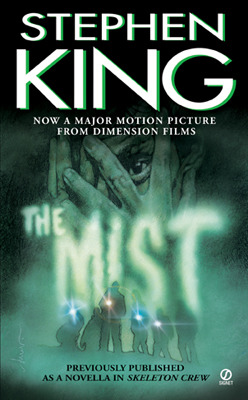
The Mist by Stephen King
This was a re-read. I listened to The Mist first when I was 12 years old (on cassette, in glorious 3D SOUND!) and remember liking it quite a bit. Then, I read it later on, in my late teens, as part of King's Skeleton Crew collection. It's funny how memory works. One thing about this story that has always stood out in my mind over the years is what I remembered to be long lists of brand names, paragraphs and paragraphs of listed brand names. When I was re-reading this, I kept waiting for those long lists to appear. They never did.
I rarely re-read books (there are just too many good books out there to read) but re-read this one in preparation for watching the film adaptation, which I hear is great.
None of the above really has anything to do with whether or not I like The Mist after all these years. I do. I think it holds up remarkably well. The only real problem I had with it was the fact that the protagonist's kid all too conveniently (for the plot) sleeps through events (on the floor of a grocery store during a crisis!) that no one would sleep through. This fairly minor quibble aside, this is a great monster story, a good post-apocalyptic story, and a really good horror story with nods to Lovecraft.
I rarely re-read books (there are just too many good books out there to read) but re-read this one in preparation for watching the film adaptation, which I hear is great.
None of the above really has anything to do with whether or not I like The Mist after all these years. I do. I think it holds up remarkably well. The only real problem I had with it was the fact that the protagonist's kid all too conveniently (for the plot) sleeps through events (on the floor of a grocery store during a crisis!) that no one would sleep through. This fairly minor quibble aside, this is a great monster story, a good post-apocalyptic story, and a really good horror story with nods to Lovecraft.
Monday, October 7, 2013
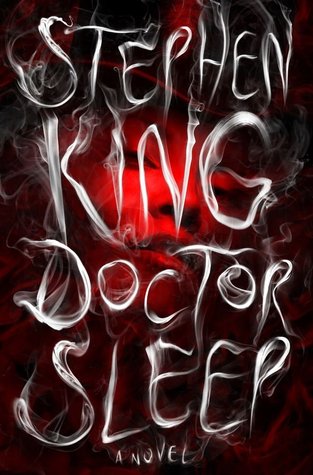
Doctor Sleep by Stephen KIng
Is Doctor Sleep as good as The Shining? No. Did I go in expecting it to recreate that experience? No. That would be silly. When you order thin crust pepperoni pizzas from Pizza Hut you expect the same thin crust pepperoni pizza every time. Books ain’t pizza. I would have been majorly disappointed if, in Doctor Sleep, Dan Torrance returned to a newly rebuilt Overlook Hotel with his own family just to find out that he’s his father’s son, then go nuts and try to smash everyone to pieces with a blunt object.
Doctor Sleep ain’t The Shining.
Instead, Doctor Sleep has more in common with Joe Hill’s NOS4A2. Both books have protagonists with special abilities who grow up to be raging alcoholics, who then learn to deal with their addictions, and get their special ability mojos back just in time to face down the bad guys. Both books feature kidnapped children as a central theme. The protagonists both have young relatives who must face the very same evil the protagonists themselves faced as a child. Both books feature cross-country pursuits. Both feature ancient ‘vampires’ of a very similar vein. The vehicles these ‘vampires’ drive are also key bits of characterization in both books. Doctor Sleep’s bad guys are like evil carnie folks, NOS4A2’s bad guy runs an evil carnival. The baddies in both books are over-the-top villains, almost cartoonish (which was a feature, not a defect, in my mind, for both novels).
By drawing the parallels above, am I trying to say something, to point out a King family conspiracy? No. Not really. It’s just interesting to note is all.
But none of this addresses the question of whether or not I liked Doctor Sleep. I did, by the way. I liked it very much. It was an engrossing page-turner, tighter than a lot of King’s later work. It has believable characters that you cared about, lots of action, and an ending that was satisfying (another somewhat rare find in a King novel). I also felt that it was a fine companion piece to The Shining, with enough ties and allusions to the original work to make it relevant, without being too referential or reverential (which would have been much, much worse). It wasn't a rehash, which I liked most of all.
If I wanted the same pepperoni pizza, I’d call Pizza Hut.
Doctor Sleep ain’t The Shining.
Instead, Doctor Sleep has more in common with Joe Hill’s NOS4A2. Both books have protagonists with special abilities who grow up to be raging alcoholics, who then learn to deal with their addictions, and get their special ability mojos back just in time to face down the bad guys. Both books feature kidnapped children as a central theme. The protagonists both have young relatives who must face the very same evil the protagonists themselves faced as a child. Both books feature cross-country pursuits. Both feature ancient ‘vampires’ of a very similar vein. The vehicles these ‘vampires’ drive are also key bits of characterization in both books. Doctor Sleep’s bad guys are like evil carnie folks, NOS4A2’s bad guy runs an evil carnival. The baddies in both books are over-the-top villains, almost cartoonish (which was a feature, not a defect, in my mind, for both novels).
By drawing the parallels above, am I trying to say something, to point out a King family conspiracy? No. Not really. It’s just interesting to note is all.
But none of this addresses the question of whether or not I liked Doctor Sleep. I did, by the way. I liked it very much. It was an engrossing page-turner, tighter than a lot of King’s later work. It has believable characters that you cared about, lots of action, and an ending that was satisfying (another somewhat rare find in a King novel). I also felt that it was a fine companion piece to The Shining, with enough ties and allusions to the original work to make it relevant, without being too referential or reverential (which would have been much, much worse). It wasn't a rehash, which I liked most of all.
If I wanted the same pepperoni pizza, I’d call Pizza Hut.
Subscribe to:
Posts (Atom)